
Reviewed · ELBPHILHARMONIE TOURS
Down Town to Speicherstadt, HafenCity and Elbphilharmonie
Hamburg is one of those cities where the past still shapes what you see on the street. This Downtown to Speicherstadt, HafenCity and Elbphilharmonie route connects merchant-city landmarks to the port’s big rebuilds, so you walk away with a clear “how Hamburg became Hamburg” story. I especially love the contrast of Speicherstadt’s red-brick warehouses with the forward-looking plan of HafenCity, and I like how the guide ties each stop to the port trade that made the city.
The one thing to consider is that this is a short, mostly outdoor walk. It covers major points fast, so if you want extra time inside museums or longer stops at memorial spaces, you may want a follow-up on your own. Also, in good Hamburg fashion, weather can change, so bring layers, even if the tour runs in all conditions.
Key highlights in plain terms
- A tight 2-hour route linking Rathausmarkt, Trostbrücke, St. Nikolai, HafenCity, Speicherstadt, and the Elbphilharmonie area
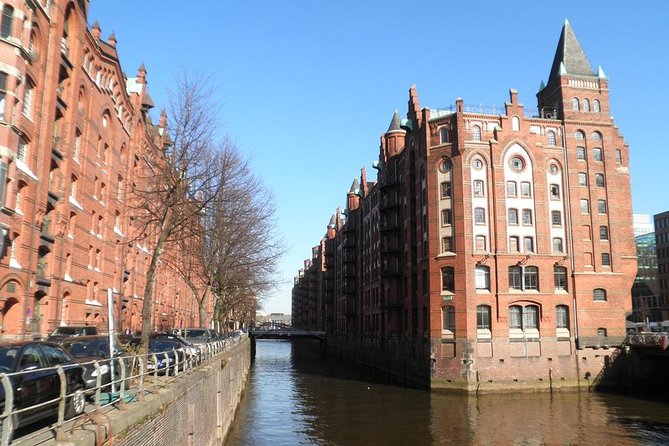
- Speicherstadt on wooden piles (the largest red-brick warehouse district of its kind) plus UNESCO World Heritage context
- Trostbrücke as the port origin explained in a way that makes ship trade feel real, not abstract
- St. Nikolai memorial + Operation Gomorrha exhibition for a grounded look at WWII’s impact
- HafenCity’s big urban change (157 ha of former industrial land turned into a new district)
- An end at the Elbphilharmonie platform so you finish with port views, not just a photo and goodbye
Why this Hamburg walk clicks: three eras in one loop
If you only have a limited amount of time, Hamburg can feel like three cities stacked together: the old merchant core, the port and warehouse belt, and then the modern waterfront rebuild. This tour is designed to stitch those parts into one easy arc.
You start at the city’s “official face” at Rathausmarkt, then move toward where commerce actually moved through town at Trostbrücke and Deichstrasse. After that, you hit the reminders and scars of the 20th century at St. Nikolai, before finishing in the future-facing spaces of HafenCity and the Elbphilharmonie zone.
That structure matters. Instead of bouncing between unrelated sights, you get cause-and-effect: water and trade bring wealth, trade shapes architecture, war reshapes the city, and urban planning reshapes it again.
And the guide is a big part of why this works. In the English-speaking experience, you may be led by someone like Jutta, who is praised for being funny, at ease in front of a group, and solid on the details without turning the walk into a lecture. For a walking tour, that combination keeps energy up and helps you remember what you saw.
More Elbphilharmonie tours:
- Hamburg: Elbphilharmonie Plaza Guided Tour
★ 4.7 · 5,882 reviews - Hamburg: Elbphilharmonie Plaza, Highlights & Surroundings
★ 4.6 · 2,270 reviews - Hamburg: Elbphilharmonie Plaza and HafenCity Food Tour
★ 4.7 · 1,711 reviews
Rathausmarkt and Hygieia-Brunnen: where Hamburg’s power shows
The walk begins at Hamburg Town Hall (Rathausmarkt). This building is a Neorenaissance statement from 1897, with a façade that reflects how the city thought of itself: a trader city with confidence, organized wealth, and civic pride. Even if you are not a hardcore architecture person, it’s an anchor point. Your brain gets a reference point fast, which helps the rest of the walk make sense.
Just behind the Town Hall is Hygieia-Brunnen, the fountain tied to the importance of fresh water. It’s easy to underestimate a fountain stop, but for Hamburg, it’s a smart one. Fresh water is not only a comfort. It connects to how cities grow, how ports function, and how everyday life stays possible.
Practical tip for you: keep an eye on your footing here. Rathausmarkt can be busy before tours, and the photos can draw you in. Take one moment for a wider view of the façade, then move on so you stay on pace for the rest of the route.
Admission here is free, so you are not losing time or budget to tickets at the first stop. You’re simply setting the stage.
Trostbrücke and Deichstrasse: the port’s story starts right in the city
Next comes Trostbrücke, described as the origin of the port of Hamburg. The key idea is how close shipping once was to daily city life. Sailing ships brought goods into the city center, where merchants were waiting. You get a sense that trade was not something that happened far away behind warehouses. It was part of the city’s rhythm.
A good guide will connect this to a major turning point: steam ships and later container vessels changed the port completely. That shift explains why HafenCity and the Speicherstadt area matter so much today. The city had to reorganize where goods landed, how they were stored, and how people lived around all that movement.
Then you continue to Deichstrasse, a historic street with houses from the 17th century. The standout part here is what the street represents: traders lived, stored goods, and worked from their own homes. That is a very different idea than zoning. Instead of separate neighborhoods for business and living, the line was blurred.
The street also holds the memory of survival. It survived a fire in 1842 and WWII, which gives the buildings a kind of “still here” weight. You are not just looking at old bricks. You’re looking at continuity.
Possible drawback to consider: Deichstrasse is a street walk, and you may find some spots better for looking than stopping. If you are the type who likes slow, long photos at every corner, you may need to balance that with the planned pacing of a 2-hour experience.
St. Nikolai memorial and the Operation Gomorrha exhibition: remembering without rushing
At St. Nikolai memorial (Mahnmal St. Nikolai), the tone changes. The steeple dates to 1874 and the space serves as a memorial for WWII victims. Underneath the ruined structure, there’s an exhibition related to Operation Gomorrha, which is the name for the Allied bombing campaign that hit Hamburg heavily.
This stop is valuable because it keeps the tour honest. Hamburg’s architecture and modern development did not come from nowhere. The city rebuilt after destruction, and that rebuilding shapes what you see in places like HafenCity.
You don’t need to be a WWII specialist to appreciate this. If you’re the kind of traveler who likes to understand why a city feels the way it does now, this memorial space gives the “why” behind the “what.”
Practical advice: expect this stop to feel heavier. Give yourself mental space. If you’re traveling with kids, decide in advance how long you want to linger. The tour keeps it moving, but the subject matters, and it can’t be rushed.
More Speicherstadt and HafenCity tours:
- Hamburg: 1.5-Hour Harbor and Speicherstadt Day Cruise
★ 4.6 · 14,200 reviews - Hamburg: 1-Hour Harbor Sightseeing Cruise with HafenCity
★ 4.4 · 3,067 reviews - Hamburg: Eerie Speicherstadt Tour
★ 4.5 · 1,394 reviews - Hamburg: Speicherstadt and Hafencity Guided Tour
★ 4.7 · 1,344 reviews
HafenCity’s 157 ha transformation: how Hamburg planned its next chapter
Then you shift to a different mood: HafenCity. This is where Hamburg shows its modern ambition and its planning brains.
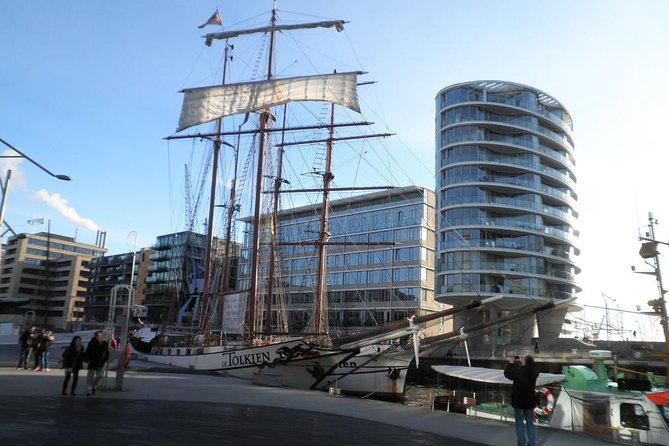
The big fact to carry with you is the scale: HafenCity is described as Europe’s largest city planning project, transforming 157 hectares of former industrial land into a completely new district. That change is not a small renovation. It’s a full rethinking of the waterfront.
You’ll pass through the area and the guide will explain the transformation story. For you, the usefulness here is pattern recognition. Once you understand that the port changed how it worked, you start seeing why HafenCity had to exist: new uses for old industrial space, new public areas, and a new relationship between people and the water.
What can be a small downside: HafenCity is still developing as parts of it evolve. Depending on the day and what’s under construction, you may see more scaffolding or temporary changes than you expect. That’s normal for a big, ongoing project. The tour’s value is the big picture, not perfection at every exact corner.
Speicherstadt, 1888 warehouses, and UNESCO brickwork on stilts
After HafenCity, you reach Speicherstadt, often the “wow” moment for people who love old-world industrial architecture. Speicherstadt is described as the largest red-brick warehouse district built on wooden piles in the world. It was inaugurated in 1888 and restored after WWII. It’s also part of UNESCO World Heritage.
This is the kind of place where you feel how Hamburg’s geography and engineering shaped daily life. Wooden piles, red brick, canals and warehouse blocks. It’s a system, not just a backdrop. And restoration after WWII means you’re seeing a rebuilt version of an older working waterfront, designed to bring back the look and function of the original idea.
For your sightseeing strategy, this is a good time to slow down. Your brain catches up to the tour’s theme. The port story you heard at Trostbrücke comes into focus: goods needed storage, storage needed infrastructure, and that’s what Speicherstadt is.
Also, each of these stops is marked as free to access for the viewing points on the route. That helps the value of the tour because you are not spending extra money on entry fees as you move from highlight to highlight.
If you are a photo person, you’ll likely want at least one longer break here for composition. Red brick plus canals plus repeating warehouse lines gives you lots of angles.
Elbphilharmonie finish: a platform view over the port
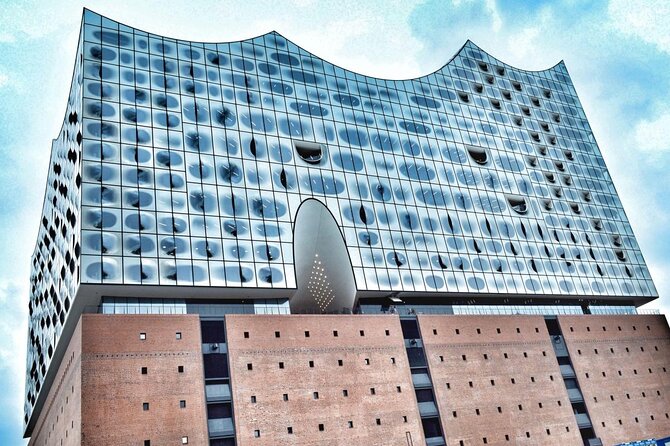
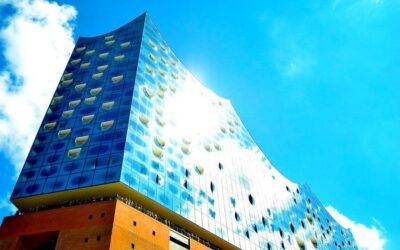
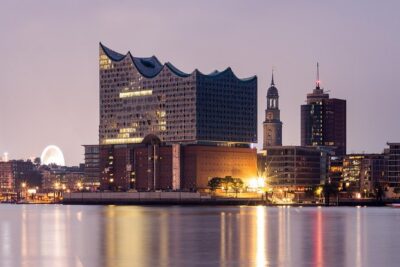
The tour ends at the Elbphilharmonie area, right in front of the building. The concert hall was inaugurated in 2016, and the first concert took place on 11 January 2017. The tour also shares the story of how it became a major venue, including mentions of its nearly perfect acoustics.
But the practical gift is the ending. You get the chance to visit the platform and enjoy views over the port. For many visitors, that final moment is what ties the whole walk together: you started with civic power at Town Hall, followed the commerce logic into the warehouse district, watched the city reinvent the waterfront at HafenCity, and then you end where culture meets the harbor.
Practical tip for you: the platform view is most enjoyable when you arrive with a small plan. Take a moment for the wide port view first, then look for details that match what you heard earlier, like the way the harbor stretches and how the waterfront design channels movement.
Admission is listed as free for the tour stops, so you are likely not paying extra at the final segment either. Your main “cost” is time, so don’t rush your last photos.
Price and value: what $30.04 buys you in real terms
At $30.04 per person for about 2 hours, this tour is priced like a solid budget-friendly way to get context without turning the day into a checklist of paid attractions.
Here’s why the value adds up:
- A professional guide is included, and the route is built around connected themes, not random landmarks.
- The stops are listed with free admission at each point you visit, so you are not stacking ticket costs during the walk.
- The group is small, with a maximum of 15 travelers, which usually means you can hear the guide and still move at a normal walking pace.
There is one tradeoff to note: transportation to and from the sights is not included. That’s typical for walking tours, and it’s not a problem if you are already using public transit or staying central.
Also, a minimum group size is required. If the tour doesn’t meet that minimum, you get an alternate date or a full refund. That’s a fair safeguard, but it does mean booking earlier can help.
Who should book this Hamburg walk, and who might skip it
This is a great fit if you want:
- A first-time-friendly Hamburg introduction that links downtown, the port, and modern redevelopment
- A guided story that explains why the city looks the way it does, not just what you’re looking at
- An English-led walk with a small group size (up to 15 people)
You might consider skipping or pairing it with something else if:
- You want lots of time inside museums. The route hits memorial and major landmarks, but it stays focused on a walking pace.
- You are traveling with a schedule that needs long stops. The tour is short by design, so you’ll be moving consistently.
This also suits most travelers who can handle a 2-hour walking experience. Service animals are allowed, and the tour operates in all weather conditions, so plan for walking in layers.
The practical way to get the most out of it
To enjoy this tour, don’t treat it like stand-still sightseeing. Treat it like a guided storyline with stop images.
A few things I recommend:
- Wear shoes you can walk in for two hours without thinking about it.
- Keep your phone charged enough for quick reference photos at Speicherstadt and the Elbphilharmonie platform.
- If you’re sensitive to heavy topics, mentally prepare for the St. Nikolai memorial stop and decide ahead of time how long you want to stay.
And if you care about humor and pace, this experience tends to benefit from guides who can bring facts to life. The praise you’ll see for the English-led tours is strongly tied to guides who keep the group engaged, like Jutta, who is described as funny and good company.
Should you book it?
Yes, book it if you want an efficient, well-paced way to understand Hamburg’s port identity, from merchant life to warehouse engineering to modern rebuilding. For the money, you get a guided storyline, a small group, free-access stops, and a satisfying ending with port views at the Elbphilharmonie platform.
Consider another plan if you need more time per location or want a museum-heavy day. This tour is about moving through key neighborhoods with context, not about slow, standalone sightseeing.
FAQ
How long is the Hamburg walking tour?
It’s approximately 2 hours.
How much does the tour cost?
The price is $30.04 per person.
What language is the tour offered in?
The tour is offered in English.
Does the tour use a mobile ticket?
Yes, it’s a mobile ticket.
Where does the tour start and end?
It starts at Rathausmarkt, 20095 Hamburg, Germany, and ends at the Elbphilharmonie area (HamburgPlatz d. Deutschen Einheit 4, 20457 Hamburg, Germany).
Is transportation included?
No, transportation to and from the attractions is not included.
Does it run in bad weather?
Yes, it operates in all weather conditions, so dress appropriately.
What are the group size limits?
The tour has a maximum of 15 travelers, and it requires a minimum of 8 people per booking.
Is there free cancellation?
Yes, free cancellation is available, and you can cancel up to 24 hours in advance for a full refund.
Recently added around Hamburg
- Hamburg Private Food Tours with a Local: 100% Personalized★ 5.0 · 3 reviews
- The Beatles on St. Pauli★ 5.0 · 3 reviews
- Short walk St. Pauli – the St. Pauli quickie★ 5.0 · 3 reviews
- Hamburg: Safari Tour in St. Pauli★ 5.0 · 3 reviews
- Private Tour: Hamburg St Pauli Nightlife District★ 3.5 · 3 reviews
- Private Tour: Speicherstadt and HafenCity Walking Tour in Hamburg★ 5.0 · 4 reviews
- Hamburg Port Promenade Tour★ 4.0 · 3 reviews
- Private Hamburg rickshaw tour for 2 people★ 5.0 · 3 reviews
Elbphilharmonie Tours, compared.
Elbphilharmonie Plaza, Highlights & Surroundings
Read our review →
Elbphilharmonie Plaza and HafenCity Food Tour
Read our review →
Elbphilharmonie Highlights and Plaza Guided Tour
Read our review →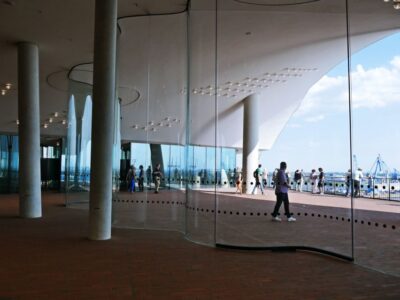
Browse the lists this tour appears in